
Las corralejas son una festividad de vieja data en la costa norte de Colombia, especialmente en los departamentos de Sucre, Córdoba y Bolívar. Aunque la relación entre los animales y los toros es tan antigua como los toros mismos, es curioso pensar que esta dicotomía bestia-hombre, mediada por la arquitectura, bien sea para darle sentido a un lugar, como las pinturas de las cuevas de Altamira, o de arquitecturas más concretas como el laberinto de Creta, de donde se origina la leyenda del Minotauro y que, aparentemente, se cree que puede tener raíz en el palacio de Cnosos. Con esto no queremos justificar históricamente una “celebración” que se encuentra cuestionada debido al maltrato animal, sino evidenciar que la arquitectura siempre está ahí, incluso para las cosas que menos nos hacen sentir satisfechos como sociedad.
Entrando en materia, las corralejas son el resultado de la herencia de la conquista; la primera corraleja conocida fue registrada en octubre de 1845 en la ciudad de Sincelejo. Al parecer, la tradición de estas fiestas de corralejas, donde se encierran a los toros para ser lidiados dentro de un corral de madera llamado corraleja, de ahí su nombre, y rodeado de palcos, se remonta a las faenas de los vaqueros de las sabanas del norte de Colombia y al “espíritu” benefactor de los grandes ganaderos y dueños de extensísimas fincas, quienes donaban o prestaban los toros para el espectáculo. Más adelante, dentro de la organización de las corralejas entraría la iglesia católica, que las utilizaría para recolectar fondos para la construcción de iglesias en diferentes rincones de la zona. En algún punto del siglo XX, entiendo que hacia la década del 60 o 70, los ganaderos empezarían a cobrar por prestar los toros, y eso le daría el carácter que tiene hoy en día. En 1980, en la ciudad de Sincelejo, se desplomaron palcos con el resultado de la muerte de más de 500 personas, lo que supuso una pausa en estas fiestas tradicionales por alrededor de 18 años. Hoy en día se realizan no solo en la región donde se originaron sino en otros lugares de Colombia y fueron declaradas como Patrimonio Cultural de la Nación en el 2009.
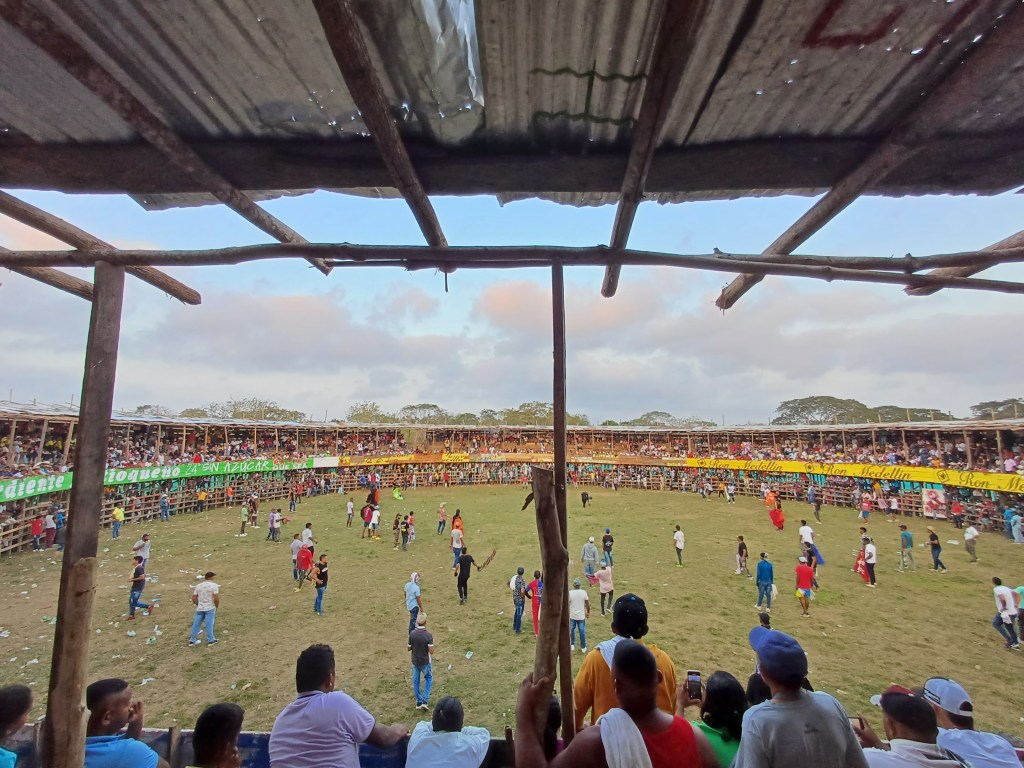
Corraleja visitada
Aunque en las Corralejas, a diferencia de las corridas de toros europeas, no se mata al animal, sí se le maltrata mediante diferentes métodos que no son objeto de este espacio; decidí ir a una corraleja a principios de 2024 para entender su funcionamiento como objeto arquitectónico. El objeto de este escrito es hacer un registro arquitectónico, muy básico y elemental, de cómo funciona una corraleja pequeña y de abrir posibles líneas de investigación sobre espacios escénicos, aunque resultaría muy interesante investigar a fondo el proceso constructivo de la corraleja, debido a que es un sistema modular de madera móvil de muy fácil construcción y bastante económico.
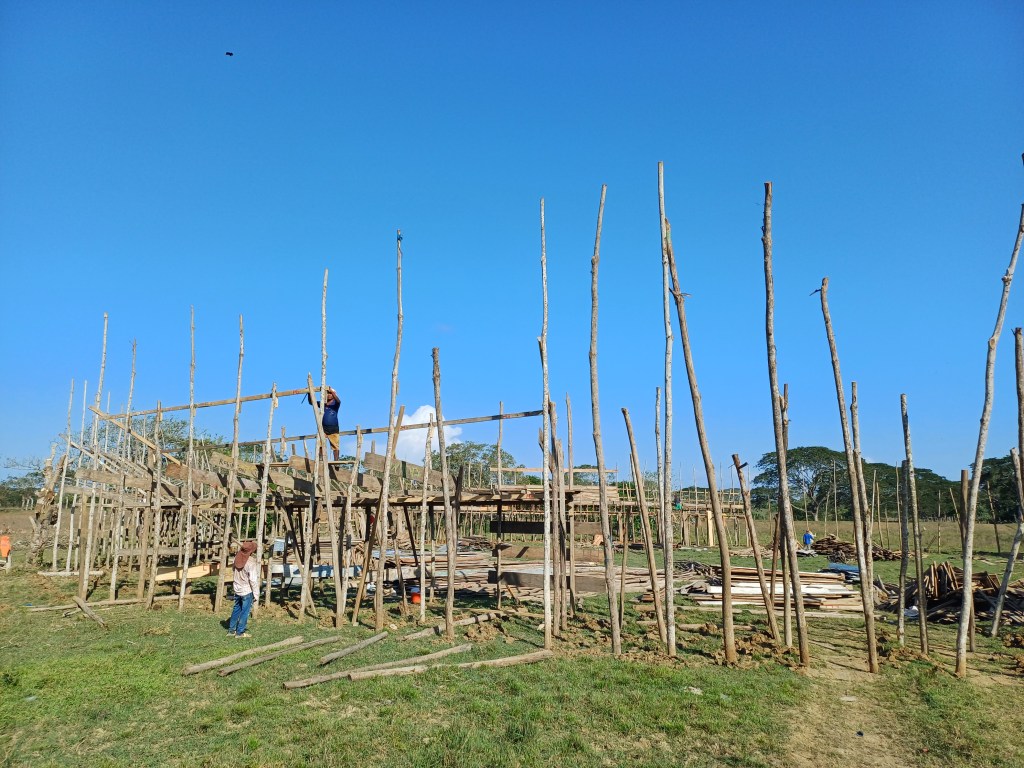
Corraleja en construcción
Para la construcción se elige un terreno, que se alquila, en algunas ocasiones se realiza una verificación del suelo por parte de un ingeniero de suelos, quien da un aval, aunque creo que aquí no fue el caso. Los horcones de madera que soportan la estructura no tienen ningún tratamiento especial, pero son de especies “duras” de alta resistencia; en este sentido, verificar el suelo es esencial pues, más que por un fallo de algún elemento, el gran riesgo que corren las graderías se da por los eventuales asentamientos que pueda tener la estructura, al menos desde mi punto de vista. Más allá de cómo los detalles de si la madera es inmunizada o no y si se le hace algún tratamiento al horcón antes de ser hincado al suelo, es importante saber que la madera va siendo rotada de evento en evento. Cada semana o cada 15 días los constructores cambian los elementos en mal estado. En esta corraleja se armaron, hincaban al menos 4 horcones en filas de diferentes alturas que ayudaban a dar forma a las graderías, en total 5 niveles más el nivel más bajo que era más ancho y permitía la circulación de personas. Aunque existen registros más académicos de estas secciones, la que pude reconstruir era más robusta y al parecer tenía más elementos; habría que ver si cada constructor tiene su sistema o si es uno solo. Los horcones o columnas recibían unas vigas inclinadas en donde se terminaban de construir las graderías mediante tablones gruesos de madera, de más de 2 cm.

Corraleja en construcción
En conjunto, las graderías finales, compuestas de la repetición de estas secciones cada metro o cada 1.5 metros, están organizadas alrededor del escenario de forma de polígono de hasta 20 lados de un diámetro de unos 80 metros. Yo calculo que podía haber fácilmente 800 personas, y en realidad la estructura se movía bastante pero nunca sentí un peligro inminente. Existe una rampa de acceso para las personas quienes deben ir llenando la corraleja deambulando por la parte baja hasta que encuentran espacio para sentarse.
Espacialmente se puede decir que las corralejas pueden tener varias configuraciones: la que visité tiene forma de polígono circular, pero en las referencias históricas se mencionan configuraciones de los palcos en forma rectangular. En la última corraleja que colapsó, se presentaba una forma en planta octogonal con dos de los lados alargados. No se sabe bien si la elección de estas formas se debe al sitio o al sistema constructivo. Valdría la pena mapear dónde se ejecuta esta forma para entender si se puede deber a la idiosincrasia de cada región, dado que las corralejas en los últimos años se han expandido más allá de las fronteras de los departamentos donde se originó.
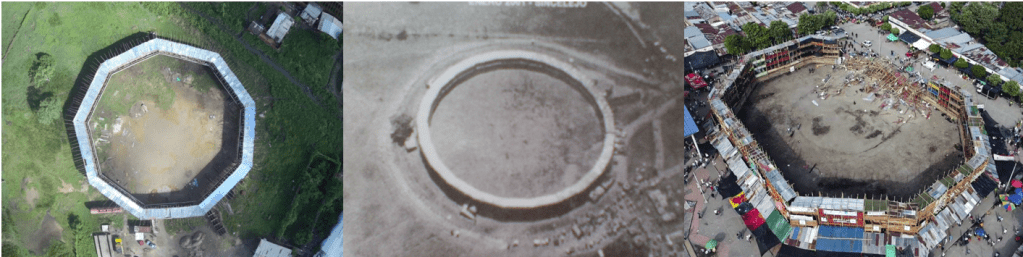
Diferentes tipos de Corralejas
Por ahora estas son las reflexiones que he hecho sobre las corralejas como arquitectura, seguramente habrá más. Como experiencia claramente puedo decir que hay bastante irrespeto por los animales, son golpeados por los espectadores sin sentido alguno. Además, son heridos con las “banderillas”. En lo personal me interesa este tipo de sistema arquitectónico por su poder de aglomerar y congregar, pero su fin es bastante cuestionable.
Enlaces Consultados
- https://www.bbc.com/mundo/noticias-61954108#:~:text=El origen de las corralejas,en esta región del país.
- https://dialnet.unirioja.es/descarga/articulo/8782772.pdf
- https://www.redalyc.org/pdf/557/55730873008.pdf
- https://www.juntadeandalucia.es/sites/default/files/2021-05/60acb15220396-caribe_colombiano.pdfhttps://publicaciones.banrepcultural.org/index.php/boletin_cultural/article/view/2983/3067
- https://www.abnoticiashoy.com/sin-corralejas-se-realizaran-fiestas-patronales-en-el-corregimiento-de-bayunca/
- https://corraleja-sdc.blogspot.com/2017/11/portada-texto-de-la-solapa-lelis.html
- https://corraleja-sdc.blogspot.com/2017/11/portada-texto-de-la-solapa-lelis.html
The Corralejas
The corralejas are an age-old festivity in the northern coast of Colombia, particularly in the departments of Sucre, Córdoba, and Bolívar. Although the relationship between animals and bulls is as ancient as the bulls themselves, it’s intriguing to consider this beast-man dichotomy, mediated by architecture, whether it be to give meaning to a place, like the paintings in the Altamira caves, or more concrete architectures like the labyrinth of Crete, from where the Minotaur legend originates and which, apparently, is believed to have roots in the palace of Knossos. With this, we do not intend to historically justify a “celebration” that is questioned due to animal mistreatment, but to highlight that architecture is always there, even for the things that make us feel the least satisfied as a society.
Getting to the point, the corralejas are the result of the heritage of conquest; the first known corraleja was recorded in October 1845 in the city of Sincelejo. Apparently, the tradition of these corraleja festivities, where bulls are enclosed to be fought within a wooden corral called corraleja, hence its name, and surrounded by stands, dates back to the tasks of the cowboys of the savannas of northern Colombia and to the “benefactor spirit” of the large ranchers and owners of vast estates, who donated or lent the bulls for the spectacle. Later on, the organization of the corralejas would include the Catholic Church, which would use them to raise funds for the construction of churches in different corners of the area. At some point in the 20th century, I understand that around the 60s or 70s, ranchers would start charging for lending the bulls, and that would give it the character it has today. In 1980, in the city of Sincelejo, stands collapsed resulting in the death of more than 500 people, which led to a pause in these traditional festivities for about 18 years. Today, they are held not only in the region where they originated but also in other places in Colombia and were declared a Cultural Heritage of the Nation in 2009.
Although in the Corralejas, unlike European bullfights, the animal is not killed, it is mistreated using different methods that are not the subject of this space; I decided to go to a corraleja at the beginning of 2024 to understand its functioning as an architectural object. The purpose of this writing is to make a very basic and elementary architectural record of how a small corraleja works and to open possible lines of research on scenic spaces, although it would be very interesting to investigate in depth the construction process of the corraleja, due to it being a modular wooden mobile system that is very easy to build and quite economical.
For construction, a terrain is chosen, which is rented, on some occasions a soil verification is carried out by a soil engineer, who gives an endorsement, although I believe that was not the case here. The wooden posts that support the structure do not have any special treatment but are of “hard” species of high resistance; in this sense, verifying the soil is essential because, more than by a failure of any element, the great risk that the stands run is due to the eventual settlements that the structure may have, at least from my point of view. Beyond the details of whether the wood is immunized or not and whether any treatment is done to the post before being driven into the ground, it is important to know that the wood is rotated from event to event. Every week or every 15 days the builders change the elements in poor condition. In this corraleja, at least 4 posts were driven in rows of different heights that helped shape the stands, in total 5 levels plus the lowest level that was wider and allowed the circulation of people. Although there are more academic records of these sections, the one I could reconstruct was more robust and apparently had more elements; it would be necessary to see if each builder has their system or if it is just one. The posts or columns received inclined beams where the stands were finished being built using thick wooden planks, of more than 2 cm.
Together, the final stands, composed of the repetition of these sections every meter or every 1.5 meters, are organized around the stage in the form of a polygon of up to 20 sides with a diameter of about 80 meters. I estimate that there could easily be 800 people, and in reality, the structure moved quite a bit but I never felt an imminent danger. There is an access ramp for people who must fill the corraleja by wandering around the lower part until they find space to sit.
Spatially, it can be said that corralejas can have various configurations: the one I visited has the shape of a circular polygon, but in historical references, configurations of the stands in rectangular shape are mentioned. In the last corraleja that collapsed, it presented an octagonal shape in plan with two of the sides elongated. It is not well known whether the choice of these shapes is due to the site or the construction system. It would be worthwhile to map where this form is executed to understand if it can be due to the idiosyncrasy of each region, given that the corralejas in recent years have expanded beyond the borders of the departments where they originated.
For now, these are the reflections I have made on corralejas as architecture; surely, there will be more. Clearly, as an experience, I can say that there is quite a disrespect for animals; they are beaten by spectators senselessly. Additionally, they are wounded with “banderillas”. Personally, I am interested in this type of architectural system for its power to agglomerate and congregate, but its purpose is quite questionable.
 Arquitectura Dispuesta
Deja un comentario